
Toilet Repair
Do I Need a Licensed Plumber to Install a Toilet?
 By Mike Mackin, Owner ·
Short answer: no. The jurisdictions where we commonly work do not require a permit and inspection to replace a toilet. But any job that moves the toilet or adds a new one crosses into permit territory, and therefore a licensed plumber. Here is where the lines actually sit, and the honest version of when DIY is fine and when it costs more than it saves.
What the rules actually say around here
Ohio licenses plumbing contractors at the state level for commercial work. For residential work, the rules depend more on the municipality: cities and counties around here, Akron, Wadsworth, Barberton, Medina, each run their own building or health departments, with their own contractor registration and permit rules.
Two things are broadly true across them. First, homeowners are generally allowed to do their own plumbing work in the house they live in. Second, anyone working on your plumbing for pay is expected to be a licensed or registered plumbing contractor in that jurisdiction. The details genuinely vary town to town, and your city’s building department has the final word. Two minutes on the phone with them beats guessing.
Permits: swapping is not the same as moving
Replacing a toilet with another toilet in the same spot, same drain, same footprint, typically needs no permit in most local jurisdictions. It is treated like replacing a faucet: a fixture swap, not a plumbing alteration.
The permit line gets crossed when the plumbing itself changes. Moving the toilet to a new spot, adding a bathroom, or relocating the drain line can mean a permit, an inspection, and a licensed plumber.
What about a handyman?
In most cities around Akron, plumbing work for hire beyond minor repairs is supposed to be done by a registered plumbing contractor, and a toilet install is usually past that line. If you are hiring anyone, ask two questions: are you licensed or registered for plumbing in this city, and are you insured? A legitimate pro will not be offended. An uninsured install that leaks through the kitchen ceiling is a very bad place to discover the answer was no.
For the record, every Mackin & Sons Plumbing tech operates under our Ohio Plumbing License #30116 and is bonded and insured.
Where toilet swaps actually go wrong
A toilet install is simple right up until it is not. After thousands of bathroom calls around Greater Akron and Medina, these are the usual trouble spots:
The shutoff valve. The little valve behind the toilet may not have been turned in years. They seize, they leak around the handle, and we have seen one or two just snap off. Bad shutoff valves are common.
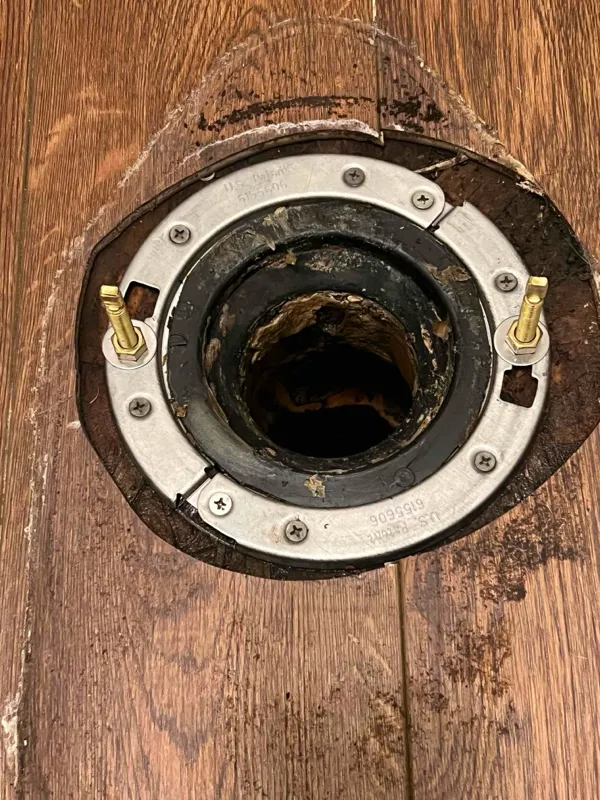
The flange. The ring bolted to the floor that anchors the toilet to the drain can be cracked, corroded, or sitting too low after a new floor went in. Cast iron flanges in a historic West Akron home are usually in rough shape, but even newer subdivisions in Medina or Doylestown can be trouble, because cheap painted-steel flange rings are common in new construction nowadays. Set a new toilet on a bad flange and it rocks, the seal breaks, and toilet water slowly leaks onto the subfloor or the ceiling below. That is the repair in the photo above: a stainless repair ring and new brass bolts over a flange that had given up.
The seal. A wax ring set crooked, or reused, leaks from day one. The stain shows up on the ceiling below, weeks later.
The rough-in. Toilets are built for a set distance between the wall and the drain, usually 12 inches, sometimes 10. Buy the wrong one and nothing you do at the install end will fix it.
If you DIY, check three things before you start
- Test the shutoff first, before you buy anything. Turn it closed. If it will not turn, will not seal, or starts weeping, deal with that before a new toilet enters the house.
- Measure the rough-in, from the wall to the closet bolts, before you shop.
- Once the old toilet is up, look hard at the flange. Solid ring, solid bolts, flange at or just above floor level: carry on. Cracked, crumbling, or buried below tile: stop there. That is the call to make before it becomes an emergency.
If the toilet mostly works and the problem is that it will not stop running, that is usually a cheap parts fix, not a replacement. We covered that one in why your toilet keeps running.
What a professional install includes
When we install a toilet, the price is flat and in writing before any work starts, and the dispatch fee, $79 in our core area and $89 in Greater Akron, is waived when you go with the work. The install includes a new wax seal, a braided stainless supply line, and heavy-duty brass closet bolts. During the diagnosis we check the shutoff valve, and if it needs replacing we include that in your options. Once the toilet is pulled, we check the flange, and if it needs repair we price that for you on the spot. We finish by hauling the old toilet away and leak-checking the whole area before we leave. Current ranges are on our pricing page, and the bathroom plumbing page covers the rest of the room.
The bottom line
You do not need a license to replace a toilet in your own Ohio home, and for a straightforward swap in a newer house, DIY is a fair Saturday project. You do need a licensed pro the moment the job is for hire or the plumbing moves, and you want one the moment the shutoff crumbles or the flange looks rough. Mackin & Sons is family-owned out of Wadsworth, serving Greater Akron since 2009, with 17,000+ jobs and a 4.9 rating across 600+ reviews. Book online or call 330-825-3686 and it is done by dinner.